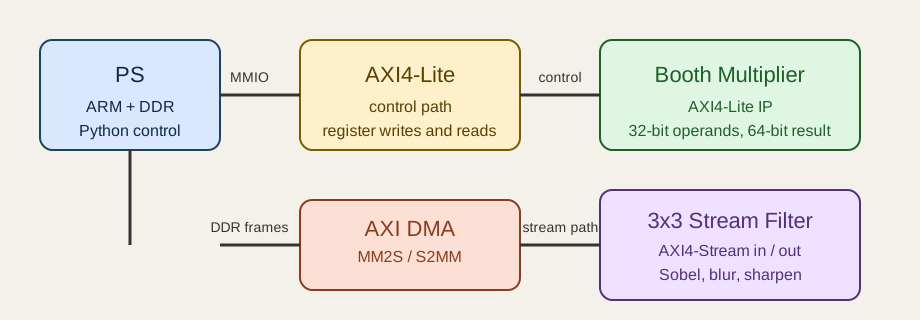
Architecture from the public partial-prototype repository.
01 / Context
The problem
An accelerator needs more than a compute kernel. Data formats, control registers, streaming behavior, host drivers, and validation have to agree across the hardware/software boundary.
02 / Ownership
My contribution
I developed the HLS paths, PYNQ Python drivers, notebooks, and host or mock tests. The suite explores both a control-oriented multiplier interface and a streaming image-processing path, with remaining board work documented explicitly.
03 / Architecture
How it works
01
Compute
Implement a radix-4 Booth multiplier and a streaming 3×3 image/filter kernel in HLS.
02
Connect
Structure AXI4-Lite control and AXI4-Stream/DMA-oriented data interfaces.
03
Drive
Expose the paths through Python drivers and PYNQ notebooks.
04
Test
Use host and mock workflows to exercise interfaces before completing board validation.
04 / Validation
Evidence & scope
Public HLS source, drivers, notebooks, and host/mock testing workflow.
Repository architecture and implementation-status documentation.
A related browser image-inspection experiment illustrates the intended image-processing workflow.
Project scope
Synthesis results, a completed bitstream, board/DMA testing, and measured speedups remain pending. The browser image-inspection view is a mock demonstration.
The hardware/software interface is part of the design. Separating host tests from board measurements makes it clear which behavior has been exercised and which claims still need a physical implementation.
 Avi Patel