Python · Process / voltage / temperature · Mock instruments · Limit checks · Reporting
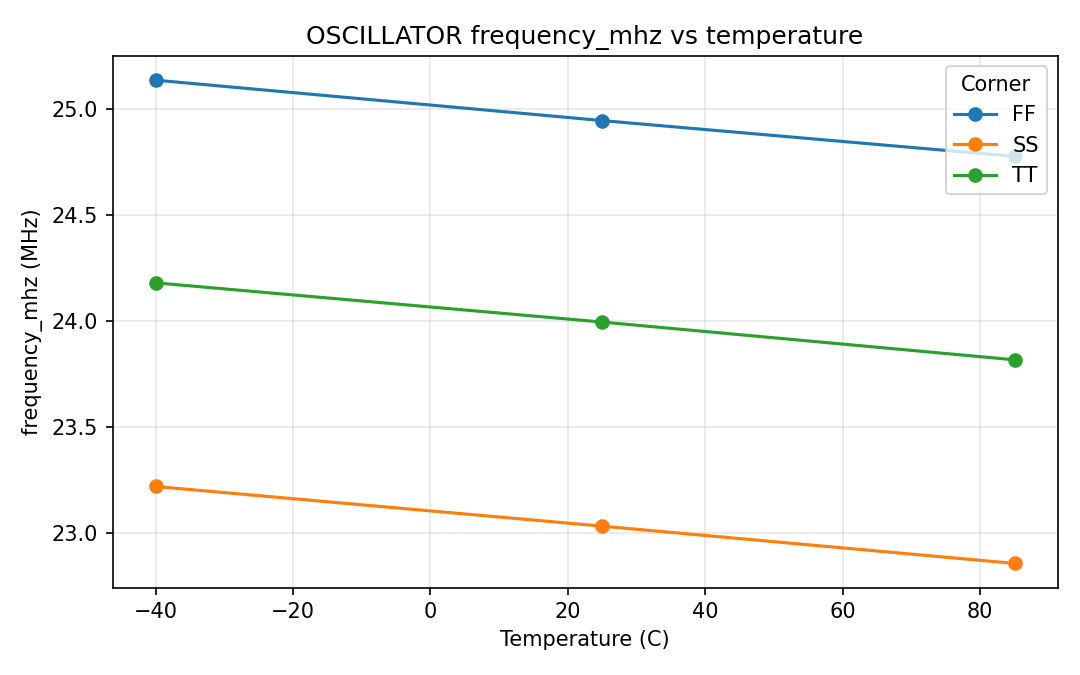
Generated oscillator data from a mock instrument.
01 / Context
The problem
A validation campaign needs consistent conditions, traceable measurements, and a clear relationship between a result and its limits. Those workflow decisions can be developed and tested before connecting a physical instrument.
02 / Ownership
My contribution
I built a simulation-capable reporting workflow for ADC-, LDO-, comparator-, and oscillator-style device models. It structures condition generation, result collection, comparison data, and pass/fail reporting around a default mock instrument.
03 / Architecture
How it works
01
Configure
Define process, voltage, and temperature conditions for a repeatable sweep.
02
Collect
Gather deterministic modeled results through a mock instrument interface.
03
Check
Apply limits and compare results across the configured conditions.
04
Report
Generate plots and summaries that retain the context of the experiment.
04 / Validation
Evidence & scope
Public Python validation and reporting framework.
Deterministic mock data and generated comparison outputs.
Plots that show modeled behavior across corners and temperature.
Project scope
Modeled devices and generated data. This is not physical silicon, bench, or ATE characterization.
A useful validation report preserves the conditions behind each result. Instrument interfaces, limit logic, and reproducible data matter as much as the final plot.
 Avi Patel